Convenience Should Never Come at the Expense of Safety
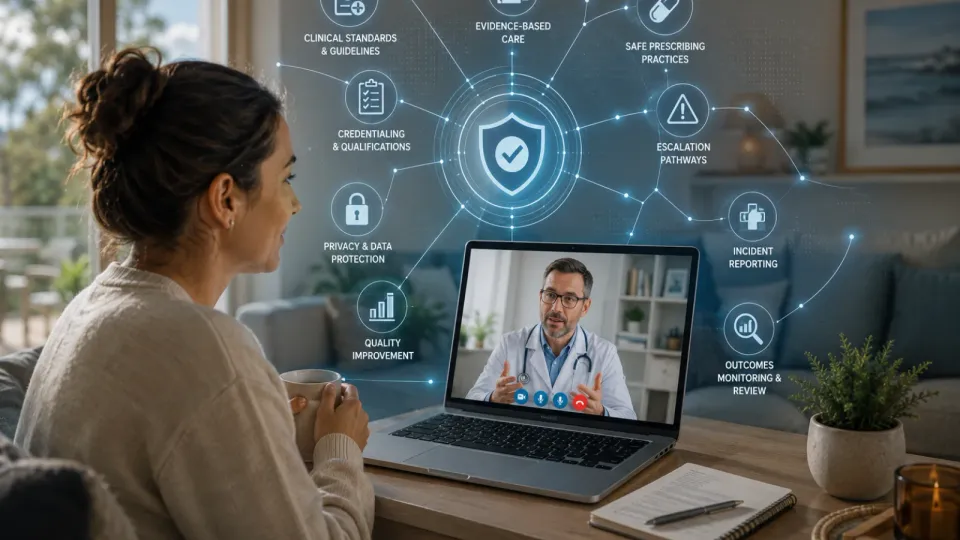
The COVID-19 pandemic changed healthcare delivery almost overnight. Social distancing, lockdowns and pressure on traditional health services required clinicians and patients to adapt quickly to new ways of accessing care. Telehealth became an essential part of that response, allowing Australians to speak with a doctor from their home while reducing unnecessary travel, waiting-room exposure and delays in receiving medical advice.
What began as an urgent response to extraordinary circumstances has since become a permanent and valuable part of modern healthcare. Today, many Australians can access a clinician from their home, workplace or while travelling, often within hours of deciding they need medical advice. For patients, this accessibility has transformed the way healthcare can be delivered.
However, the rapid expansion of telehealth also reinforced an important lesson: convenience alone is not enough.
Patients understandably value shorter waiting times, easier access and the ability to receive care without leaving home. But these benefits should never replace sound clinical judgement or appropriate safeguards. Whether a healthcare decision is made in a hospital, a general practice or through telehealth, it must ultimately be guided by one question:
Is this the safest and most appropriate way to care for this patient?
The answer depends not only on the clinician or the technology being used, but on the systems, governance and accountability that sit behind every consultation.
The Safety Patients Never See
When patients attend a consultation, they naturally focus on the clinician sitting in front of them. What they rarely see are the policies, procedures and governance systems working quietly in the background to support safe clinical decision-making.
These are the systems that keep you safe.
These systems determine how clinicians diagnose your condition, manage common presentations, recognise when a patient’s condition requires escalation, prescribe medications appropriately, protect patient privacy, respond to side-effects and adverse events, and continuously review the quality of care being delivered.
Collectively, these processes are known as clinical governance.
Although largely invisible to patients, strong clinical governance that is designed by professionals, implemented with diligence, and meticulously maintained and updated forms one of the most important indicators of a high-quality healthcare service.
Good Telehealth Knows Its Limits
One of the most common misconceptions about telehealth is that success is measured by the number of consultations completed remotely.
In reality, the opposite is often true.
Telehealth is about care, convenience and inclusion. It is about ensuring that everyone is able to have access to treatment no matter where they are, whether they are deep in rural Australia, or bed-bound a block away from our consulting physician; we want a system of medicine that can safely deliver this to you.
Telehealth is not about speed or volume.
High-quality telehealth recognises when a patient should not continue with a virtual consultation.
Some conditions can be safely assessed and managed remotely. Others require physical examination, diagnostic testing, or urgent medical intervention. The role of telehealth is not to replace traditional healthcare, but to identify the most appropriate pathway for each individual patient.
A patient experiencing uncomplicated hay fever may receive assessment and treatment entirely through telehealth. A patient describing chest pain, severe abdominal pain, neurological symptoms, or signs of serious infection requires a different response. In these situations, a safe telehealth service recognises the limitations of remote assessment and facilitates timely referral to face-to-face care or emergency services. When that happens, our system of governance ensures that the patient knows exactly what to do next.
Escalation is not a failure of telehealth. It is good governance in action.
When the system works the way it should, not only will the patient benefit, but the whole medical system will as well.
Building Trust Through Governance
Trust has always been central to healthcare.
Patients trust clinicians to make decisions that place their wellbeing above convenience, cost, or efficiency. That trust should extend beyond individual practitioners to the organisations providing healthcare.
Strong clinical governance helps create that confidence by establishing clear clinical standards, evidence-based guidelines, appropriate prescribing frameworks, credentialling processes, quality improvement activities, incident reporting systems, and regular review of clinical outcomes.
These systems provide consistency across an organisation, ensuring patients receive safe, high-quality care regardless of which clinician they consult.
As telehealth continues to grow, governance will become increasingly important. Technology can improve access to healthcare, but technology alone cannot guarantee quality. Safe healthcare depends on the people, processes and accountability that support every clinical decision.
Safety Enables Accessibility
The future of healthcare will not be defined by a choice between telehealth and face-to-face medicine. It will be defined by how intelligently these pathways work together to ensure patients receive the right care, in the right setting, at the right time.
Telehealth can improve access, reduce unnecessary travel and connect patients with clinicians more quickly. Yet its long-term success depends on something less visible: the clinical governance systems that support safe prescribing, recognise risk, establish clear escalation pathways and continually review the quality of care being delivered.
Patients should never have to choose between convenience and safety. The highest-quality telehealth services understand that these are not competing priorities. Accessibility brings healthcare closer to the patient; strong governance ensures that the care delivered remains safe, appropriate and worthy of their trust.
As healthcare continues to evolve, the organisations that earn lasting confidence will not simply be those offering the fastest appointment or the newest technology. They will be those that combine innovation with responsibility and ensure that every patient is supported through the most appropriate clinical pathway.
Convenience may encourage patients to try telehealth for the first time.
Confidence in its safety is what will keep them coming back.
References
- Fisher K, Davey AR, Magin P. Telehealth for Australian general practice: the present and the future. Aust J Gen Pract. 2022;51(8):589-593.
- Javanparast S, Roeger L, Kwok Y, Reed RL. The experience of Australian general practice patients at high risk of poor health outcomes with telehealth during the COVID-19 pandemic. BMC Fam Pract. 2021;22(1):58.
- Australian Commission on Safety and Quality in Health Care. National Safety and Quality Health Service Standards. Clinical Governance Standard. 2nd ed. Sydney: ACSQHC; 2021.
- Royal Australian College of General Practitioners. Telehealth-only services position statement. Melbourne: RACGP; 2024.
- Australian Health Practitioner Regulation Agency. Guidelines for registered health practitioners who use telehealth in their practice. Melbourne: Ahpra; 2023.
- Australian Commission on Safety and Quality in Health Care. National Model Clinical Governance Framework. Sydney: ACSQHC; 2017.
- Australian Commission on Safety and Quality in Health Care. National Safety and Quality Primary and Community Healthcare Standards. Clinical Governance Standard. Sydney: ACSQHC; 2025.
- Australian Institute of Health and Welfare. Australia’s health 2024: in brief. Canberra: AIHW; 2024.
Individual results vary based on your circumstances and clinical needs. Telehealth is not suitable for all health concerns. Your practitioner may recommend in-person assessment, urgent care, GP review, specialist referral, further investigation or no treatment depending on your circumstances.
If you would like to speak with a qualified clinician from home, check your suitability here and find out whether Velora HealthConnect is the right fit for you.
Luke McPherson
Director of Clinical Operations